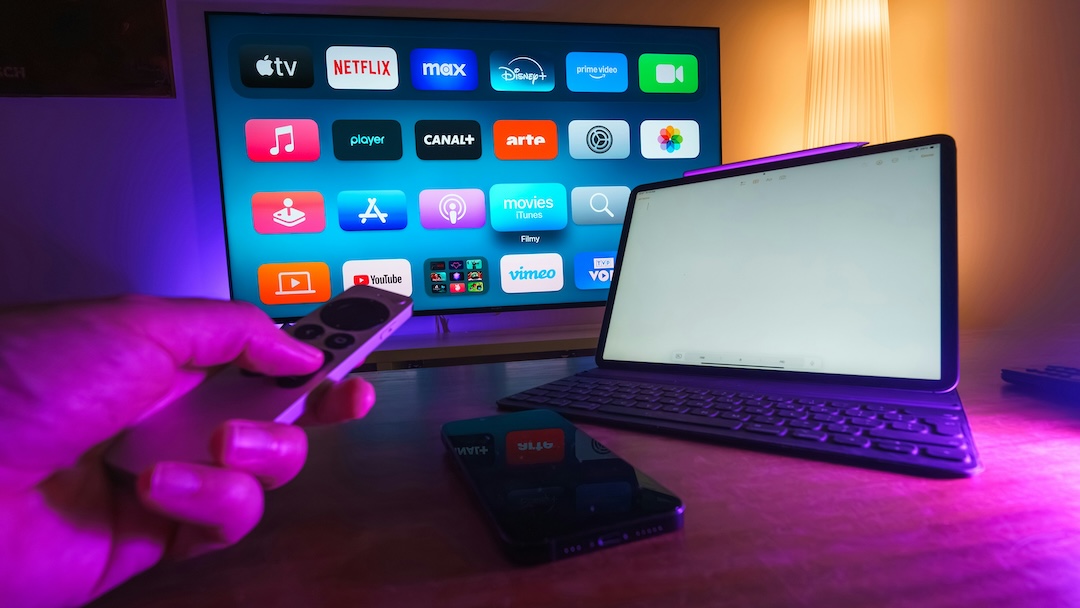
Streaming has become THE way people view media, and we’ve seen wonderful improvements in resolution over the last decade. If you’ve decided it’s finally time to look for a new TV, streaming stick, or app for a higher-quality picture, you’ve probably read “4K” in the marketing claims. But what is 4K streaming exactly? And do you really need it?
The answer, honestly, depends on more than the label on the box because a 4K screen can only show a 4K picture if the video reaches it fast enough. That’s where things can get confusing. Terms like Mbps, bitrate, and “up to” speeds get tossed around, so it’s difficult to tell what your internet plan and TV can actually handle.
Let’s clear up some of the confusion by breaking down what the numbers mean, how much speed and data 4K requires, which services offer 4K content, and whether 4K is really the upgrade your home needs.
What Is 4K Streaming?
First, the basics: 4K streaming is video that’s delivered over your internet connection at ultra-high-definition resolution—3840 x 2160 pixels. For some perspective, that’s 4 times higher than your standard resolution of 1920 x 1080.
To watch at such a high resolution, you need three things:
- A 4K-capable screen
- A device or app that supports 4K
- And a fast, stable internet connection
You’ll often see “4K” and “UHD” (for ultra-high-definition) used interchangeably. They mean about the same thing for home streaming. Though, technically, 4K is a slightly wider cinema format, while TVs and streaming services use UHD. (We don’t need to quibble about the minor differences.)
4K content also often comes with HDR (that is, high dynamic range) in formats like HDR10 or Dolby Vision (with up to 12-bit color). HDR adds brighter highlights, deeper shadows, and richer color, which is why 4K can look so much better and sharper than HD in the right situations.
Mbps, Gbps, “Up To”: What Do These Streaming Speed Terms Actually Mean?
The first thing to understand is that 4K describes picture quality. Not speed. Your internet speed is a separate measurement of how quickly data travels to your home. The speed then affects how well a 4K stream actually plays: Smoothly? Or slowly?
What’s challenging is that internet providers, streaming services, and device makers all use slightly different terms. Here’s a quick guide:
| Term | What it means | Why it matters for streaming |
| Mbps | Megabits per second—the standard unit for internet speed | Streaming services list their requirements in Mbps |
| Gbps | Gigabits per second (1 Gbps = 1,000 Mbps) or 1 billion bits per second | Common in fiber plans—far more than a single stream needs |
| MB/s | Megabytes per second (1 byte = 8 bits) | Often shown in download apps, so it can look slower than your plan |
| Download speed | How fast data reaches your device | This is the most important number when it comes to streaming |
| Upload speed | How fast data leaves your device | This is important for video calls and gaming, for example, not for watching |
| “Up to” speed | The maximum your plan can deliver | Real-world speeds—especially over Wi-Fi—are often lower |
| Bitrate | How much data a video uses per second | Higher bitrate means better quality and more bandwidth is needed |
How Much Internet Speed Do You Need for 4K Streaming?
Most streaming services recommend between 15 and 25 Mbps of download speed for a single 4K stream. That’s the minimum for one TV, not for the whole household of streaming devices. Keep in mind, every other device on our network is also drawing from the same connection at the same time.
| Service | Recommended speed for 4K |
| Netflix | At least 15 Mbps and preferably 25 Mbps |
| Disney+ | 25 Mbps |
| Prime Video | 15 – 25 Mbps |
| YouTube | At least 20 Mbps with 25 to 50 Mbps recommended to prevent buffering and account for other devices |
| Apple TV | At least 25 Mbps for a single device |
This can quickly add up. For example, 2 people streaming 4K in different rooms can use 50 Mbps together. Add a video call, online gaming, checking social media on your phone… it doesn’t take long for a 50 Mbps plan to start to struggle if the entire family is online. If you too have a busy household, a plan of 100 Mbps or more gives you a lot more headroom.
How Much Data Does 4K Streaming Use?
4K streaming uses about 7 GB of data per hour on Netflix, almost twice what HD uses. Other services have a higher range, as noted in the table above. So, if your internet plan has a data cap because you’re on a lower-tier satellite, 5G home internet, or mobile hotspot, even a few 4K movie nights can eat up a good chunk of your monthly allotment.
What Else Do You Need for Smooth 4K Streaming?
Good internet speed isn’t the only part of the equation. To stream in 4K, you need every link in the chain supporting it. That includes:
- A 4K TV or monitor that ideally also supports HDR
- A 4K-capable streaming device or app—some older streaming sticks and smart TV apps top out around 1080p
- The right subscription tier—Netflix and other services reserve 4K for premium plans only
- A powerful home network with a modern Wi-Fi 6 or 6E router placed close to the TV. For the most reliable, high-bandwidth connection, you may want to consider a wired Ethernet cable
- Capable HDMI connection. This one is easily overlooked as many folks just grab the most affordable cable. For the best picture, it pays (and is often essential) to have HDMI 2.0 or newer cables and ports with HDCP 2.2 support.
If any of the links is weak, the entire 4K chain will likely drop to HD—even if most of the other links are strong.
Which Streaming Services Even Offer 4K Content?
Today, most major streaming services offer 4K content, including Netflix, Disney+, Prime Video, Apple TV, HBO Max, Paramount+, and YouTube. That said, not every title is available in 4K. And some services only include 4K on higher-priced plans. As mentioned above, Netflix, for example, limits 4K to its Premium tier. So, before you upgrade your TV, it may be worth checking both the plan details and the shows you watch to see if 4K even matters.
Even less of live TV is broadcast in 4K. Most 4K programming is limited to major sporting events and select specials through live TV streaming services (think YouTube TV and Fubo) as a 4K add-on.
So, which is the best streaming service for 4K?
Since picture quality is comparable between all the major services, it usually comes down to which library of shows you think you’ll enjoy most.
Do You Really Need 4K (or More)?
For most average viewers, 4K is a nice upgrade rather than a must-have. While picture quality is higher with 4K, on a smaller TV or from usual viewing distances, it’s pretty hard to spot the difference between 4K and 1080p. You’re more likely to notice improvements with a faster, more reliable connection and a home network that keeps up with everyone using it than 4K or higher.